Monday, October 5, 2009

A Unique Two Show Day


SHOW ONE:

Soccer chat outside the theatre, as the mob assembles...

1) We had offered to add an extra show on Sunday afternoon when we arrived. The festival had said yes. Little did we know what would lie ahead.

2) We show up at the theatre, and we're ready for our 2:30pm curtain time. Unlike last night, there are only six audience there for the start. I talk to them. All are university students. They say the timing of our show is very bad - there are important exams tomorrow for almost everyone. They also say the advertising has been poor, and that nobody knows about this aded show. We ask them if they would prefer to come back to the evening show, when there will be more people. They deliberate. This deliberation stretches on. A few more people arrive. Then a few more. We decide to go ahead with the show. At some point, someone tells us that a group of students expect to use the auditorium to watch a Champion's League soccer game at 5:30. We say we don't want this to delay our evening show, and then don't think much about it. We being our matinee about an hour late.

3) At intermission, a group of men arrive. There are two student leaders, and the Director of the Centre, Jena-Marie. The students are vibrating with anger. They are the organizers of the soccer match. Gloria and Kiki from the festival arrive. A discussion begins that gets increasingly heated. There has been a lack of comunication between the two groups. The theatre folks have the official booking, but the soccer folks have numbers - as we talk, hundreds of soccer fans begin to gather outside. The student leaders are rude and barely in control. Laurette, our translator, begins speaking to them in Kinyarwanda, saying they can't just take over the building in the middle of a play. The man she is speaking to begins to shout at her, and raise his arms. Laurette recoils, afraid, raising her arms to shield herself, stumbling backwards. I scream at the man in my loudest actor voice. This stops him. I tell him, quite volubly, that i am the director of the play, and that if he has an argument, it is with me, not with her. He dials everything back, and the discussion continues. All this is during our intermission. Some of the actors begin to gather. Our audience is wondering what to do. All is being captured on camera by the film crew. Finally, the soccer boys are pursuaded to step outside. Amy says to me - "Soccer is important here - we should let them watch their game". She's right. I go outside to tell Kiki that i will be happy to cancel the show tonight, if it becomes an either/or situation. We then learn that the match ISN'T at 5:30. It's at 4:30. We are currently at 4:15.

4) We begin the second half of the show. Outside, a mob is gathering. Lili's second act monologue about the genocide is accompanied by the sounds of hundreds of men just outside the building. The actors rise to the occasion and turn in piercing performances. Our audience is entirely focused. I am not. Nor are Rebecca and Guillaume. We exchange worried looks. I finally slip outside to see what's happening.

5) Outside, I find Rick and Stefan, who had agreed to stay with the discussion when it moved outside. Rick tells me there is now a compromise. We will finish our show, and immediately set up the giant screen, and open the main auditorium doors. The soccer fans will miss only part of the first half. Rick tells me the scene was a nervous-making. At one point, there were five theatre people standing in front of the closed doors, and hundreds of men staring at them, wanting to be inside. That is the energy i step out into, but it dissipates quickly, as the news spreads through the crowd that they will be let in soon. Later that night, Jean-Marie, the Director, speaks to me. He apologizes, but says the students in such a situation can turn violent, and it's best to let them have their way.

Wow.

6) Our show finishes. We spring into action. The hall fills with men. Chelsea versus Liverpool comes to Butare on a giant screen. At Rick's suggestion, Gloria finds the young soccer organizer and drags him over to Laurette. He apologizes for threatening her. The apology is sincere. Laurette is very upset, still. She accepts his apology. She then tells us that he is a friend of hers, and she cannot understand how he could have done that.

7) I watch a bit of the match. It's really good. Then go for a beer.


SHOW TWO

The evening show goes much more smoothly. The crowd is almost all male, but they are riveted to the show. I believe that the language barrier adds to this attention, but nonetheless we have a good show. The local police commissioner attends. He asks questions at the talk-back - wondering why we had some details in the play, and not others. He speaks about the machinery of genocide: the army, the decision-makers, the militias, the propaganda, the elaborate facilitation of murder. He wanted to see a more complete revelation of this complex and powerful machinery. I answer that there is so much that we leave out because of the time constraint of the play. We have 2 hours to tell a story that is bigger than our imaginations - so our playwright makes choices, focuses on the personal as a way to speak to the societal. We hint at the powers that are engaged during such killings, but we don't focus on them. He is satisfied by this answer. Later, he tells me that he really liked the play, but still wants this story told, examined: the machinery of mass murder.

Like so many of the audience, like so many people on the streets, he is young.


Sunday, October 4, 2009

Goodness Opens in Rwanda

Saturday, Oct 1.

This is one of the biggest days of my life.

Rebecca and Laurette at load-in. Laurette works on the Kinyarwanda synopsis. Rebecca runs the lighting hang.

The indomitable Rick Banville. And his broom.

Rick atop the rickety scaffold, refocusing a light.

Rebecca and Guillaume in the 'booth".

Our audience begins to arrive.

The after-party at the Hotel De Mont Huye. Jack serenades.


Lili Matabishi, an actress based in Kigali (coincidentally, i had recently read about a show she was in New York - a Rwandan production of The Investigation, by Peter Weiss). Lili is tremendous - and offers to handle our publicity in Kigali - all from the goodness of her heart.

1) We're at the theatre at 9am. Our crew is two cracker-jack Belgian technicians, and the never-daunted Rwandan technical director, Judo. The Belgians came to teach a workshop, and assist, and have ended up working very long hours just to make the tech possible. Judo is the epitome of competence and friendly energy. We will have only this one day to install our seating (we're performing on the stage of the large theatre, with the curtains drawn, and the audience with us on the stage), clean the stage and dressing room, hang and focus our lights, set our sound levels and light levels, rehearse, and open at 8:30pm. We work in three languages.

2) It's a lot of work. But it goes well, mostly. There is a scare when one of the Belgians, Carrie, atop a rickety scaffold, is nearly electrocuted. The voltage here is 240, and he gets a shock that sends him cursing down the scaffold in seconds - not bad for a man who weighs well over 200 pounds. The gear is not all in the best of shape. Some is new, some is old, all comes from different continents, and is difficult to make work together. We take a break.

3) We begin to realise that there isn't much help to be had, outside of Gloria, and the core crew. It's an election day, and the whole country is not working. We have to carry all the seating ourselves across campus from the library - Rick, Guillaume, myself, and a student good enough to help. 70 chairs in several trips under a hot African sun. Two risers we wanted are locked in a room elsewhere in town, and the man with the key makes it clear to Gloria that he is not coming in to work until Monday. That's after our closing. So, we make do. The dressing room needs a substantial cleaning, and Gloria brings mats and a rug from her house to make a pleasant space for the actors.

4) Rehearsal begins at 2pm. We gather outside under a spectacular tree for notes. The atmosphere is charged. We are all acutely aware that we are about to open a play about genocide in Rwanda. The film crew is present, and documents everything.

5) Song rehearsal in the dressing room. Then a few scenes are run to make sure they are tight. We move to the stage.

6) Onstage, there is a problem. The lighting board we are using is new, and has been brought for us from Belgium. None of us have seen a board like this before, and Rebecca can't get it to record cues. This discovery is made when the Belgians have gone on their dinner break. We call them, and Manu comes back. He, too, can't get the board to work. Out comes the instruction manual. They figure it out, and we can begin making light cues. But there is now only about an hour and a half of rehearsal time left. We jump from cue to cue. Rebecca works as fat as she can. We build the lighting for the first act, then lose the actors to their dinner break. Rebecca builds the second half with Rick and i pretending to be the cast. Guillaume works on sound levels, and setting up all the props.

7) We finish, and actually get a dinner break ourselves (we had worked through lunch). We're ready to open. Nerves ensue.

8) We have a full house at 8:30 - on time. We hold for ten minutes, for a few stragglers. I give a curtain speech in French and English that Laurette translates into Kinyarwandan (Laurette speaks about half a dozen languages). And then Michael Redhill's Goodness begins.

9) I don't relax. I sit behind the audience, and watch both the show and the crowd. The show is ON. The actors are charged and giving the performances of their lives. The audience is silent. There is no laughter at the jokes, almost no visible reaction at all. But there is silence and focus. Intermission happens. A group of young men leave. The rest of the audience returns. I still have no idea what is happening. Are people understanding this complicated, English drama? Are they silent because they are bored? Offended? I have no idea. It's disquieting, to say the least.

10) The show ends. The audience rises to its feet. Cheers. Oh. My. God.

11) We hold a post-show talk. It is an intense experience. There are comments that are tremendously moving. Gloria speaks of how this play helps her reconcile what happened to her family in the genocide. Kiki asks if art can do anything, if a play can have any effect. Several people ask why is this play called "Goodness". IS there goodness? One woman - Lili - speaks of how this play tells her that this experience - genocide - is shared, or born, by people the world over. The actors are asked to speak to why they are doing this play - what does it mean to them. I hear my friends speak with a deep honesty about this project, and its significance in their own lives. It is very emotional. Big questions are asked, and answers are struggled with, because there are no answers to many of them. At the same time, there is a large group of yong men who say nothing, ask no questions, simply listen. What are they thinking? I have no idea. The experience of this talk is almost too big for me to process.

12) We party. We go back to the hotel and drink and sing. Rick plays Jack's guitar. Jack plays Jack's guitar. They are both amazing musicians. Jack's voice is stirring. We then ask for some songs from the Africans who have joined us. Kiki and Lili (the Rwandan Lili - not our Lili) sing a Rwandan ballad. It is one of the saddest songs i've heard. Gloria sings a haunting lullaby. Pamela teaches us a refrain, and as we all sing it, she speaks a poem about the struggles in her homeland of Northern Uganda. It is colossally moving. A man named Sammi borrows the guitar - which he plays masterfully - and sings a song in Swahili that his father wrote. It is beautiful. We drink and talk and sing through the night. Until the Dutch man (we think he's Dutch) across the compound finally asks us to keep it down. We're mostly in bed by 4am. Some are still up, though, when i retire.

What a day. A day like no other.


The Opening of the Festival

October 2 - in Butare

We awake in Butare. Today the actors will have the day off. Rick, Guillaume and I will prep for our opening tomorrow - retrieving, in particular, the handgun we are borrowing from the Army for our show. We will all attend the opening ceremony in the afternoon, and another show in the evening.

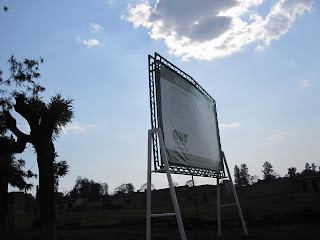
The sign by the front gate of the National University of Rwanda, where we will be performing.

A menu from the restaurant in the Super Market on the main street, where we buy our water, whiskey and wine. It seems the Philly Cheese Steak knows no bounds, geographically.

The view on the walk to the University from downtown.

Kiki Katese (left) and Gloria Magambo (right) join us at our hotel.

We meet a Colonel from the Rwandan Army. He is in charge of the battalion that is stationed in the four southern districts of the country. He is also the man who has arranged to lend us a handgun for use in the show. It's a disabled US Army issue Colt. Gloria, who comes along, has never really seen a gun, and asks about it. The colonel calls the Colt a "stick", and not something for killing. If you want to kill someone, you use one of those, he says, indicating the machine guns the soldiers in the next room are carrying. He shows her bullets from his own handgun, which he carries tucked into his belt.

My first interview on Rwandan television. I speak in English, and Guillaume speaks in French.

The boys that live in a house outside the gate of our hotel. Amy gave them some hats, and a Leafs t-shirt.


Jeanie and Laurette at dinner on the main street in Butare.


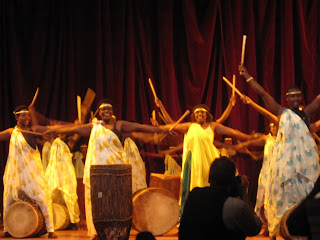
The Women Drummers at the opening ceremony. Mind blowing.


Dancers at the opening ceremony. All the dancers were orphaned during the genocide. All were wonderful.

Playwright and poet Pamela Acaye outside our theatre at the National University of Rwanda.


1) The day of the opening ceremony. We see the Rwandan Women Drummers. Drumming was a male preserve before the genocide. Now, women have taken possession of the drum, and they are transcendent. The joy with which they drum, the power of it: beyond words. We see a troop of dancers - all orphans from the genocide, now young adults. We see a dance theatre piece made by a choreographer from France, a music director from Burkina Faso, and our host, Kiki, who wrote the text and performed the role of the mother. The story was that of the lone surveying son of a family killed in the genocide. The other characters are ghosts - played by dancers. Astonishing imagery.


This is an amazing place to be.


2) I realize i should introduce our cast of characters:


The Actors: Lili Francks, Gord Rand, Tara Hughes, Amy Rutherford, Jack Nicholsen, Layne Colemen


The Technical Cohort: Rick Banville, Production Manager; Rebecca Picherack, Lighting Designer; Guillaume Houët-Brisebois, Stage Manager.


The Rwandans We Know: Gloria Magambo, works with the Festival Arts Azimuts, the woman who is making it all happen for us; Laurette Kabanyana, our translator and guide, a lovely and very bright woman, whom it seems all men in town are smitten with, (i don't blame them); Kiki Katese, the artistic director of the festival, a woman who is bearing a lot of stress these days; Judo, the technical director.


The Ugandan: Pamela Acaye, a playwright and friend of Gloria - special-ness incarnate.


The Belgians: there are two. Carie and Manu. They are the technicians we work with. They are tireless.


The Film Crew: John Westhauser, DOP and co-director of the documentary being made about this tour; Tyler Cook, sound man and the youngest of us all (aka "John Smith" - from the hotel reservation that was made for him before we knew his name!);


The Significant Others: Jeannie Calleja, Gord's wife, and AD for the documentary; Stefan Monnet, Amy's partner, along for the trip, and generally helpful.


These are good people to spend this time with, time that will change us all.

Friday, October 2, 2009

The Volcano Bus: from Kigali to Butare


Thursday, Oct 1 - a long day continues...


Ditch repair on the road to Butare - the roads are in amazing condition.

The bus that arrives for us at the Milles Collines, for the trip to Butare.

A work gang of prisoners on the road to Butare.

Arrival at the Motel de Mont Huye in Butare

At a hardware store in Butare - a long translated negotiation to buy supplies for home-made footlights.

Rick at the Mont Huye - a beautiful place

1) We get caffeine at Bourbon Coffee in Kigali.

2) We get in the Volcano Bus. Seriously. Volcano. Gets in. The Volcano Bus.

3) We are driven south to Butare. About 3 hours. When they say Rwanda is the land of a thousand hills, they underestimate. It is rolling, beautiful, crowded, cultivated land. People work with hand tools. The roads are in amazing shape. Drivers are much less crazy than in Uganda, or Montreal. We see farmers, students, women with bundles on their heads, prisoners in work gangs wearing bright orange jumpsuits. We see the evidence of both genocide, and recovery. It is a big drive.

4) We arrive in Butare, in Huye district. Much bigger than we thought. The Hotel de Mont Huye is lovely.

5) We meet Gloria Magambo - who will become our guide and organizer. Gloria works for the festival, and is Help incarnate. She quickly becomes our hero. We visit a hardware store to buy wire, bulbs, and fixins for the homemade footlights we will need for the Kigali shows (we will be performing in a restaurant). We choose a different venue to do the show in in Butare - on the stage of the large Main Auditorium at the National University of Rwanda (a very beautiful campus). We begin to make plans for the lighting hang, sound and riser installation.

6) In a cab back from the theatre, I have my first conversation about the genocide. Gloria grew up in Uganda, exiled. She was a child when the genocide began. Her father escaped with her. They walked to Uganda. She is now the only relative her father has left. Rick asked her where she feels her home is. Nowhere, she says. In Uganda, she was called a foreigner. In Rwanda, she speaks the native language only haltingly. She is caught between places.

But she is radiant, and very good at her job.


Arrival

On the runway.

Gord anticipates disembarkation.

Room party in the Hotel des Milles Collines, Kigali (aka the Hotel Rwanda).

Breakfast at the Milles Collines the next morning. Eggs taste like eggs. Fruit tastes like fruit. SOOO much better than in Toronto.

We go to change money at a local establishment recommended to us by Laurette - our local liaison. The Obama bill was on the door.

We arrive in Kigali at just before 2am on Thursday, Oct. 1.

1) We are met by Laureete Kabanyana - our "fixer" Steve's associate. Steve is currently in Lebanon, but Laurette will stay with us from here on to translate, and problem-solve as necessary. Laurette is lovely. We are 14 Canadians, and we occupy one van, two taxis and Laurette's car for the 30 minute drive into the centre of town.

2) We check into the Hotel des Milles Collines - made famous in the West by the movie Hotel Rwanda. The Milles Collines is under renovation, but it's a welcome and comfortable place after our very long trip. We open some Nairobi duty-free in Rick Banville's room, and toast our safe arrival.

3) We pass out and sleep. Breakfast at 9. Out to change money and buy phones at 10am with Laurette. Back to the hotel for the drive to Butare at 1pm.

We're here.

Thursday, October 1, 2009

30 Hours, Part Two

Flew more. Here are more images:

The map on the seat-back screen. I realized that I was flying over places i had never heard of before...

Arrival in Nairobi. Spent several hours at the airport here, and rendezvoused with the rest of the gang, who had arrived from Amsterdam about 20 minutes before me. 2 Nigerian beers were sampled: Tusker and White Cap. I think White Cap edged out Tusker - but they were neck and neck, so to speak.

Our first African fauna: a cockroach. Fast little guy...

Airplane three: Nairobi to Bujumbura, Burundi. We would wait there for refueling, and new passengers, then continue on to Kigali.

Kenya Airways making sure everyone is getting on the right plane...

30 hours

Flew. A lot. Here are some images:

First airplane. 747 Air France from Toronto to Paris Charles de Gaulle. Slept almost the whole flight.

Paris Charles de Gaulle, Terminal 2F. Spent several hours here. Watched Jacob's Ladder on iTunes.

Airplane number 2: 767 from Paris to Nairobi.